Ghana economic outlook 2026: The hidden opportunities smart investors, entrepreneurs, and businesses cannot afford to ignore
Ghana has steadily positioned itself as one of Africa’s most resilient and opportunity-driven economies. While global markets continue to navigate uncertainty caused by inflation, geopolitical tensions, supply chain disruptions, and fluctuating commodity prices, Ghana continues to demonstrate remarkable determination toward economic transformation. For investors, entrepreneurs, multinational corporations, startups, exporters, and policymakers, understanding Ghana’s economic outlook has become more important than ever before.
The future belongs to economies that prepare today. Ghana is no longer simply an emerging market. It is becoming a strategic gateway to West Africa, offering expanding opportunities across technology, agriculture, manufacturing, renewable energy, infrastructure, tourism, education, healthcare, mining, and financial services.
Businesses that understand these economic shifts early will position themselves ahead of competitors. Those who wait may discover that the best opportunities have already been claimed.
Why Ghana continues to attract global attention
Ghana has earned a reputation for political stability, improving governance, expanding infrastructure, and increasing digital innovation. These strengths have made it one of Africa’s preferred destinations for foreign direct investment and regional business expansion.
International businesses increasingly view Ghana as a launchpad into the Economic Community of West African States (ECOWAS), providing access to a regional market of hundreds of millions of consumers.
Several factors continue supporting Ghana’s long-term growth.
The country’s young and ambitious population is creating a vibrant workforce filled with innovation and entrepreneurial energy. Rising internet penetration continues accelerating digital business opportunities. Mobile banking and financial technology are transforming how individuals and businesses manage transactions. Infrastructure investments continue improving transportation, logistics, and connectivity across major commercial centers.
These developments create a positive foundation for sustained economic growth.
GDP growth remains encouraging
Economic growth is expected to remain positive as government reforms, increased private sector participation, stronger exports, and improving investor confidence contribute to national development.
Several sectors are expected to drive future GDP expansion.
Agriculture remains one of Ghana’s strongest economic pillars. Cocoa, cashew nuts, fruits, vegetables, fisheries, and livestock continue supporting employment while generating export earnings.
Manufacturing continues gaining momentum as local industries expand production capacities to reduce import dependency.
Mining remains a major contributor through gold production while new investments in critical minerals continue attracting international attention.
Oil and gas production continues supporting national revenue despite global energy market fluctuations.
The services sector, particularly telecommunications, digital finance, healthcare, education, and logistics, continues expanding rapidly.
Together, these industries strengthen Ghana’s economic resilience.
Inflation and monetary policy
Inflation remains one of the major concerns affecting households and businesses across many developing economies, including Ghana.
Higher food prices, imported inflation, fuel costs, and currency fluctuations have created challenges for consumers and businesses alike.
The Bank of Ghana continues implementing monetary policies designed to stabilize inflation while maintaining economic growth.
As inflation gradually moderates, purchasing power is expected to improve, creating stronger consumer confidence and increased business activity.
Businesses that effectively manage operational costs while maintaining product quality will likely outperform competitors during this transition.
Investment opportunities continue expanding
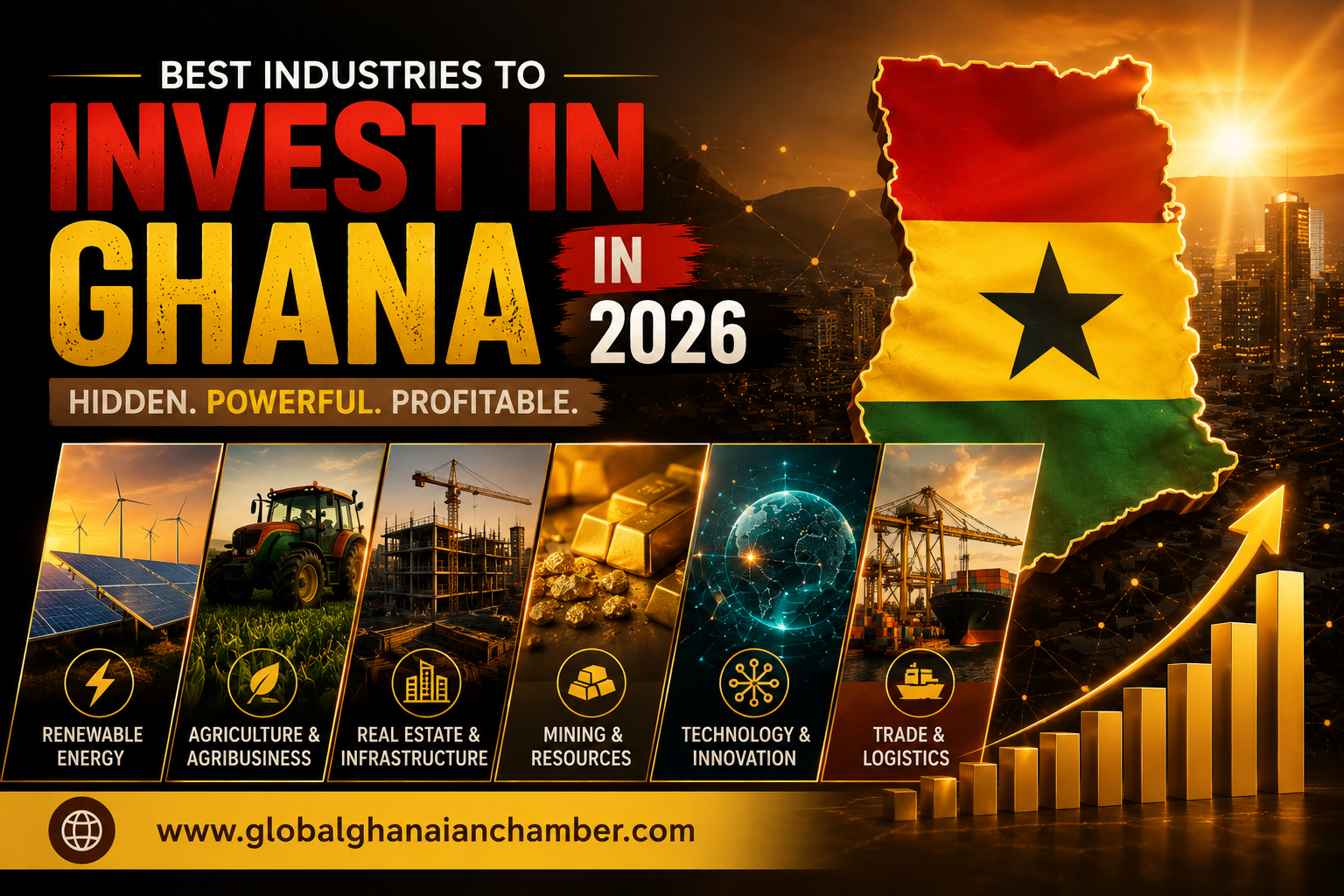
One of Ghana’s greatest strengths lies in its diverse investment landscape.
Investors are no longer limited to mining or oil.
Technology startups continue attracting venture capital funding as digital entrepreneurship expands across sectors including healthcare, education, logistics, agriculture, and financial services.
Renewable energy projects are gaining momentum as sustainability becomes a national and global priority.
Agribusiness presents enormous opportunities in food processing, packaging, export development, precision farming, irrigation technology, and value-added agricultural products.
Real estate continues growing through affordable housing, commercial developments, industrial parks, and mixed-use projects.
Tourism and hospitality also offer significant long-term opportunities as Ghana strengthens its international tourism appeal through cultural heritage, historical destinations, eco-tourism, and business travel.
Ghana’s digital economy is accelerating
Digital transformation is reshaping every sector of Ghana’s economy.
Businesses increasingly rely on cloud computing, artificial intelligence, cybersecurity, digital payments, automation, and data analytics.
Consumers now expect faster online services, secure payment systems, personalized experiences, and efficient customer support.
Small businesses that embrace digital transformation today will enjoy greater competitiveness tomorrow.
E-commerce continues expanding as internet accessibility improves across urban and rural communities.
Digital marketing has become essential rather than optional.
Companies investing in online visibility, search engine optimization, social media marketing, and customer experience are capturing larger market shares.
Entrepreneurship is becoming the driving force
Across Ghana, entrepreneurship is changing lives.
Young innovators continue launching businesses across fintech, agriculture, logistics, healthcare, education, manufacturing, tourism, and creative industries.
Government initiatives, startup incubators, innovation hubs, private investors, and development organizations continue supporting entrepreneurial ecosystems.
Small businesses no longer compete only within local communities.
Digital platforms now allow Ghanaian entrepreneurs to reach regional and international customers faster than ever before.
Those who prioritize innovation, customer satisfaction, operational efficiency, and technology adoption will create stronger businesses capable of sustainable growth.
Infrastructure development strengthens competitiveness
Infrastructure remains one of the strongest indicators of long-term economic progress.
Road networks, ports, airports, industrial parks, digital connectivity, energy infrastructure, and logistics improvements continue supporting business expansion.
Improved transportation reduces operational costs while increasing efficiency across supply chains.
Reliable infrastructure attracts international manufacturers seeking regional production facilities.
As infrastructure expands, rural communities also gain greater access to markets, healthcare, education, and financial services.
Agriculture remains a powerful growth engine
Agriculture continues supporting millions of livelihoods while contributing significantly to national exports.
Modern farming techniques are transforming traditional agriculture through mechanization, precision farming, improved irrigation systems, climate-smart agriculture, and digital farm management.
Food processing presents one of the largest untapped opportunities.
Rather than exporting raw commodities, Ghana has increasing opportunities to develop value-added products for regional and international markets.
Investments in storage facilities, cold chain logistics, packaging technology, food safety standards, and export certification will significantly strengthen agricultural competitiveness.
Manufacturing offers long-term potential
Industrialization remains central to Ghana’s economic development strategy.
Local manufacturing reduces import dependency while creating employment opportunities and strengthening domestic supply chains.
Growth opportunities include pharmaceuticals, food processing, textiles, construction materials, consumer goods, automotive assembly, packaging, plastics, and industrial equipment.
Manufacturers adopting automation, lean production systems, quality certifications, and sustainable practices will improve global competitiveness.
Renewable energy creates new opportunities
Global demand for sustainable energy continues increasing.
Ghana possesses significant potential across solar energy, wind power, biomass, and hydroelectric development.
Renewable energy investments support environmental sustainability while improving long-term energy security.
Businesses adopting clean energy solutions often reduce operational costs while enhancing corporate reputation among environmentally conscious consumers and investors.
Challenges businesses should prepare for
Every growing economy faces challenges alongside opportunities.
Businesses operating in Ghana should prepare for inflationary pressures, currency fluctuations, changing regulations, global commodity price volatility, infrastructure gaps in certain regions, climate-related agricultural risks, and increasing international competition.
However, organizations that prioritize strategic planning, innovation, financial discipline, digital transformation, and continuous workforce development often convert challenges into competitive advantages.
Preparation consistently outperforms reaction.
Why global businesses are watching Ghana closely
International corporations increasingly recognize Ghana as one of Africa’s strategic investment destinations.
Its political stability, improving regulatory environment, expanding consumer market, growing middle class, and regional trade opportunities create attractive conditions for long-term investment.
Companies entering Ghana today may benefit from first-mover advantages in rapidly growing sectors.
Waiting until markets become saturated often means competing against established players with stronger local networks and customer loyalty.
The future belongs to prepared businesses
Economic forecasts should never be viewed merely as reports.
They are strategic roadmaps.
Every economic trend tells a story about future opportunities.
Every investment decision made today influences tomorrow’s growth.
Every entrepreneur who embraces innovation creates new possibilities not only for their business but also for national development.
Ghana’s future will not be defined solely by government policies or global markets. It will be shaped by visionary entrepreneurs, responsible investors, resilient businesses, skilled professionals, and innovative communities willing to build sustainable economic progress together.
The question is no longer whether Ghana offers opportunities.
The real question is whether businesses are prepared to recognize those opportunities before everyone else does.
Those who invest in knowledge, embrace technology, strengthen partnerships, improve operational excellence, and think beyond short-term profits will be the organizations leading Ghana’s next chapter of economic success.
The future rewards preparation. Every day spent waiting is another opportunity someone else may already be seizing.
If your goal is sustainable growth, regional expansion, and long-term profitability, Ghana deserves serious attention. The country’s economic journey is still unfolding, and those who act with vision today may become the success stories others study tomorrow.