Listings Are the New Storefronts: How FISE Is Turning Global Visibility Into Opportunity for SMEs, Artisans and Grassroots Creators
The world has changed. A business no longer needs to wait for customers to walk through a physical door. Today, customers search first, discover second, compare third and buy later. That means your listing is no longer just an entry in a directory. It may be the first storefront your customer ever sees.
For millions of small businesses, artisans, makers, entrepreneurs and grassroots creators, this shift represents both a serious challenge and an extraordinary opportunity.
The question is no longer simply, “Do you have a business?”
The more urgent question is:
“Can the world find you?”
That is where the vision behind The Furniture Times (TFT), Furniture Industry Search Engine (FISE), FISE LIVE and the FISE Searchology Inclusion System™ becomes increasingly important.
TFT tells their story.
FISE helps the world find them.
And together, they point toward a much bigger idea: visibility should not be reserved for businesses with enormous advertising budgets, sophisticated marketing teams or established digital reputations.
Visibility should be an opportunity.
For the entrepreneur working from a small workshop.
For the artisan whose skills have been passed from one generation to another.
For the furniture maker trying to reach international buyers.
For the grassroots creator building something meaningful with limited resources.
For the SME that has a great product but remains invisible in search.
For the human being behind the business who deserves to be discovered.
This is the thinking behind the emerging concept of FISE Searchology Inclusion System™ — a global visibility engine designed around SMEs, artisans, makers and grassroots creators.
And it challenges us to rethink one of the oldest concepts in commerce.
The storefront.
The Storefront Has Moved
For generations, businesses invested heavily in physical storefronts.
They chose the location.
They designed the sign.
They polished the windows.
They displayed their products.
They made the entrance inviting.
They wanted people passing by to stop.
The storefront was a business’s first impression.
But the modern customer may never walk past your physical location.
They may never see your sign.
They may never know your workshop exists.
They may never discover your showroom.
Instead, they open a search engine.
They type a question.
They search for a product.
They look for a supplier.
They compare businesses.
They investigate brands.
They read descriptions.
They explore images.
They look for credibility.
And within seconds, they decide which businesses deserve their attention.
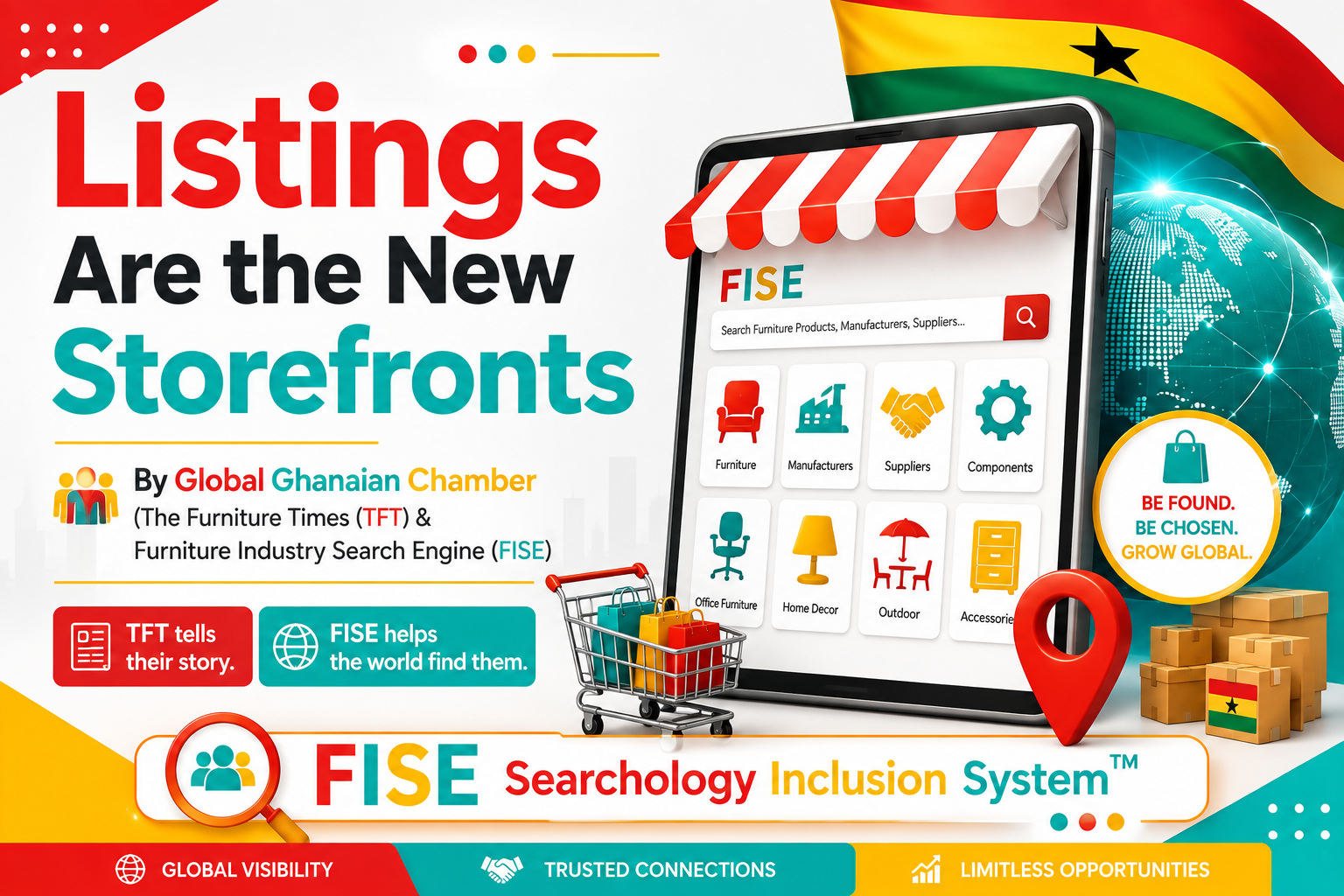
That search result has become the new storefront.
Your listing has become your sign.
Your profile has become your shop window.
Your business information has become your introduction.
Your digital identity has become your first handshake.
And your discoverability has become part of your competitive advantage.
This is why listings can no longer be treated as an afterthought.
A weak listing can make a strong business invisible.
A missing listing can make a legitimate company look nonexistent.
An incomplete listing can make an artisan impossible to understand.
And a poorly structured digital presence can cause opportunities to pass silently to competitors.
TFT Tells the Story. FISE Helps the World Find It.
There is an important distinction between telling a story and being discoverable while telling it.
A business may have an extraordinary story.
It may have decades of experience.
It may employ skilled craftspeople.
It may create exceptional products.
It may support a community.
It may preserve traditional knowledge.
It may manufacture responsibly.
It may serve customers across borders.
But if the digital world cannot find the business, much of that value remains hidden.
This is where the relationship between The Furniture Times and FISE becomes powerful.
TFT tells their story. FISE helps the world find them.
The first creates narrative.
The second creates discoverability.
One gives businesses a voice.
The other helps that voice travel through the digital ecosystem.
And when these functions work together, a listing becomes far more than a name and an address.
It becomes a digital doorway into a business.
Why Visibility Is Becoming a Business Survival Issue
There was a time when location could determine success.
A shop on a busy street had an advantage.
A showroom near a commercial district had an advantage.
A business located near a major market had an advantage.
Today, digital visibility can create an entirely different kind of location advantage.
A small manufacturer in a developing market can potentially be discovered by an international buyer.
An independent artisan can potentially reach customers beyond their hometown.
A furniture maker can potentially become visible to architects, designers, hospitality businesses, distributors and procurement professionals.
A grassroots creator can potentially move from being unknown to being discoverable.
But there is a critical condition.
They must exist where people search.
This is why the idea of a global search and visibility ecosystem matters.
The internet has connected the world.
But connection alone does not guarantee discovery.
There are millions of businesses online.
There are millions of products.
Millions of websites.
Millions of social media profiles.
Millions of creators.
Millions of manufacturers.
Millions of service providers.
The problem is not simply a lack of information.
The problem is information overload.
When everyone is online, being online is no longer enough.
You must become findable.
From Business Listings to Digital Identity
Traditional business directories often treated a listing as a simple record.
Business name.
Address.
Phone number.
Website.
Category.
Perhaps a short description.
But today’s digital environment demands a broader perspective.
A modern listing can become part of a company’s digital identity.
It can communicate:
Who are you?
What do you make?
Who do you serve?
Where do you operate?
What makes you different?
What industries do you support?
What products do you offer?
What markets do you serve?
What expertise do you possess?
What story stands behind your business?
What proof can people find?
What should someone search to discover you?
These questions transform the concept of a listing.
A listing is no longer merely where your business is. It is increasingly about why your business matters.
That is a major shift.
The Rise of FISE Searchology Inclusion System™
The FISE Searchology Inclusion System™ represents a powerful concept: creating a global visibility engine specifically focused on SMEs, artisans, makers and grassroots creators.
The underlying philosophy is bigger than creating another directory.
It is about inclusion in the digital discovery economy.
It is about giving businesses a structured opportunity to establish and strengthen their presence where discovery increasingly happens.
It is about connecting identity with visibility.
It is about making the digital ecosystem more inclusive for businesses that may not have the financial resources to compete with multinational corporations for attention.
And most importantly, it recognizes something that is frequently forgotten in the digital economy:
Behind every listing is a person.
Behind a workshop is a family.
Behind a small manufacturer is a team.
Behind an artisan product is often years of knowledge.
Behind an SME is someone’s risk, investment, ambition and livelihood.
That changes the meaning of visibility.
Visibility is not only marketing.
Visibility can become economic opportunity.
This Is Not Just a Business Listing System
The most powerful part of this vision is the recognition that this is not just a business listing system.
It can be understood through several interconnected dimensions.
A Livelihood System
Small businesses are not merely businesses.
They are livelihoods.
An SME can support employees, suppliers, families and communities.
An artisan workshop can preserve an income stream for an entire household.
A small manufacturer can create employment.
A grassroots creator can turn a skill into sustainable work.
When these businesses become easier to discover, the potential impact extends beyond the company itself.
One discovered business can represent many supported livelihoods.
That is why digital visibility deserves to be treated seriously.
A Human Impact System
Behind every company profile is a human story.
Someone decided to start.
Someone took a risk.
Someone learned a skill.
Someone invested savings.
Someone built a product.
Someone kept going when the business was difficult.
Digital platforms can easily reduce businesses to data points.
But meaningful visibility should do the opposite.
It should help people discover the humans, craftsmanship, creativity and purpose behind those businesses.
Technology should not erase the human story. It should help amplify it.
A Search Revolution
Search behavior is changing.
People are not only searching for company names anymore.
They search questions.
They search solutions.
They search categories.
They search products.
They search suppliers.
They search locations.
They search industries.
They search specific needs.
They search conversationally.
They ask increasingly detailed questions.
This means businesses need to think beyond simply having a website.
They need to think about how people discover them.
This is where the concept of Searchology becomes particularly relevant.
The goal is not merely to be present.
The goal is to build an ecosystem where businesses can become more meaningfully connected to the ways people search for products, services, companies, makers and opportunities.
A Digital Identity Movement
Every serious business deserves a recognizable digital identity.
Not just a logo.
Not just a website.
Not just a social media page.
A complete identity should help establish what the business is, what it offers and why someone should care.
For an SME, digital identity can become an important bridge between local credibility and global discoverability.
For artisans and makers, it can turn craftsmanship into searchable knowledge.
For grassroots creators, it can transform an invisible idea into a discoverable opportunity.
A Global Opportunity Engine
Perhaps the biggest idea is opportunity.
The global economy contains buyers searching for suppliers.
Companies searching for partners.
Architects searching for manufacturers.
Hotels searching for furniture.
Retailers searching for products.
Distributors searching for brands.
Consumers searching for unique creations.
Investors searching for promising businesses.
Collaborators searching for talent.
Yet opportunity cannot reach a business that cannot be found.
FISE’s larger vision is therefore not simply about listings. It is about creating pathways between businesses and the people looking for them.
FISE LIVE: Turning Visibility Into a Living Experience
A static business profile can provide information.
But businesses are not static.
They launch products.
They attend events.
They tell stories.
They introduce innovations.
They participate in industries.
They build relationships.
They create conversations.
This is where the concept of FISE LIVE becomes significant.
A live visibility environment can make business discovery feel more active, current and connected.
Instead of simply asking, “Who is this company?”, the digital audience can begin asking:
“What are they doing now?”
What are they launching?
What are they showcasing?
What are they creating?
Where are they participating?
What opportunities are available?
Who are they collaborating with?
The future of digital discovery will increasingly belong to ecosystems that do more than store information.
They will connect people, stories, businesses and opportunities.
Why SMEs Cannot Afford to Ignore Digital Visibility
For a large corporation, losing a few potential customers may not create an immediate crisis.
For a small business, one major client can change the year.
One distributor can open a new market.
One hospitality contract can transform production.
One international buyer can create new employment.
One strategic partnership can unlock growth.
This is why SMEs should not think of digital visibility as something they will worry about later.
Later is often when competitors have already occupied the space.
If your business is not clearly represented online, someone else may become the answer to the question your future customer is asking.
If you manufacture outdoor furniture but cannot be discovered when buyers search for outdoor furniture manufacturers, your production quality does not matter at that moment.
If you are an artisan but your work cannot be found by people searching for handmade products, your craftsmanship remains hidden.
If you are an SME with an exceptional product but weak digital identity, your competitor with stronger discoverability may win the attention before you even enter the conversation.
The first battle is often not price. It is visibility.
The New Competition Is for Discovery
Businesses traditionally competed on:
Price.
Quality.
Location.
Service.
Distribution.
Brand reputation.
Today, there is another battlefield.
Discovery.
Who appears first?
Who gets noticed?
Who looks credible?
Who answers the customer’s question?
Who is easier to find?
Who has the clearest digital identity?
Who appears relevant?
Who has the strongest searchable presence?
These questions are becoming increasingly important.
The company that wins attention may get the opportunity to compete.
The invisible company may never even enter the race.
What This Means for Artisans and Makers
Artisans have something that digital platforms desperately need: authenticity.
A handmade product carries a story.
A traditional craft carries heritage.
A maker carries expertise.
A workshop carries history.
But traditional craftsmanship can struggle to compete with businesses that have larger marketing budgets.
A global visibility ecosystem can help address part of that imbalance by giving artisans structured opportunities to establish their presence.
Imagine a buyer searching for a particular craft.
Instead of finding only major commercial brands, the buyer can discover independent makers.
Imagine an architect searching for unique furniture.
Instead of seeing only mass-market options, the architect can discover specialized workshops.
Imagine a retailer searching for handmade products.
Instead of relying exclusively on large suppliers, the retailer can discover emerging creators.
Search can become a bridge between hidden talent and global demand.
The Grassroots Creator Should Not Be Invisible
Some of the world’s most meaningful businesses begin quietly.
A person starts from home.
A creator makes something after work.
A family builds a small workshop.
A craftsman serves a local community.
A young entrepreneur develops an idea.
A maker turns a personal skill into a business.
They may not have a large advertising budget.
They may not have a professional marketing department.
They may not understand every technical aspect of digital marketing.
But that should not automatically mean they disappear from the digital economy.
Inclusion means creating more pathways for these businesses to be discovered.
This is why the phrase global visibility engine for SMEs, artisans, makers and grassroots creators carries such importance.
It puts the focus back on the businesses that form the foundation of countless communities.
From Local Business to Global Discovery
One of the most exciting possibilities of digital visibility is the ability to change the geography of opportunity.
A local business can become globally discoverable.
A regional artisan can attract international interest.
A small manufacturer can find overseas buyers.
A niche creator can connect with a specialized audience.
A company that once depended entirely on local foot traffic can build digital pathways toward new markets.
This does not guarantee success.
But it creates something incredibly valuable:
A chance to be discovered.
And sometimes, opportunity begins with nothing more than being visible at the exact moment someone is looking.
Your Listing Is Your First Sales Conversation
Think about the moment a customer encounters your business online.
They have never met you.
They do not know your team.
They have not visited your factory.
They have not touched your product.
They have no personal relationship with you.
Your digital presence has to introduce you.
That means your listing should answer important questions quickly.
What do you do?
What do you sell?
Who do you serve?
Where are you located?
Why should someone trust you?
What makes you different?
How can someone contact you?
What should they do next?
A strong listing does not simply provide information.
It reduces uncertainty.
And reducing uncertainty is one of the foundations of conversion.
From Visibility to Action
Visibility without action is incomplete.
A business may receive impressions but no inquiries.
A listing may receive views but no contacts.
A company may be discovered but not understood.
That is why businesses must build their digital presence around action.
Your listing should encourage the next step.
Contact the company.
Visit the website.
Request information.
Explore products.
Ask for a quotation.
Start a conversation.
Book a meeting.
Become a partner.
Discover the story.
The ultimate goal of visibility is not vanity. It is opportunity.
What Businesses Should Do Now
The digital marketplace is not waiting.
If you are an SME, artisan, maker or grassroots creator, this is the moment to audit your digital identity.
Start by asking yourself whether your business is easily discoverable.
Search your company name.
Search your products.
Search your category.
Search the phrases your customers would use.
Search your location and industry together.
Then ask an uncomfortable question:
If I were a stranger searching for exactly what my business offers, would I find me?
If the answer is no, do not ignore it.
Fix it.
Create a stronger digital identity.
Build accurate business information.
Use meaningful descriptions.
Clarify your products and services.
Highlight your expertise.
Tell your story.
Make your business searchable.
Create consistency across digital platforms.
Develop a clear call to action.
And explore visibility ecosystems designed to help businesses become more discoverable.
The Urgency Is Real
The businesses that will benefit from tomorrow’s digital economy are not necessarily the biggest businesses.
They may be the businesses that become easiest to discover.
That distinction matters.
A company can be excellent and invisible.
A competitor can be average and highly visible.
The market does not always reward the best product first.
It often rewards the product the customer discovers first.
That is why the age of digital storefronts is already here.
The question is no longer whether listings matter.
The question is whether businesses are treating their listings with the seriousness they deserve.
FISE Is Bigger Than a Directory
The most ambitious vision behind FISE is not simply creating another place where businesses can place their names.
It is about creating an ecosystem around discovery.
A livelihood system.
A human impact system.
A search revolution.
A digital identity movement.
A global opportunity engine.
That vision matters because the digital economy should not become a game where only the companies with the largest budgets can be seen.
There should be room for the small manufacturer.
The independent designer.
The traditional artisan.
The family-owned business.
The grassroots creator.
The emerging entrepreneur.
The specialist supplier.
The local maker with global potential.
The business that has never had a chance to tell its story beyond its immediate community.
The Future Belongs to Businesses That Can Be Found
The next generation of commerce will not be defined solely by who has the biggest storefront.
It will increasingly be defined by who has the strongest digital discoverability.
The storefront has moved.
The sign has moved.
The first impression has moved.
The search journey has moved.
And businesses need to move with it.
TFT tells their story.
FISE helps the world find them.
FISE LIVE keeps discovery connected to what is happening now.
And the FISE Searchology Inclusion System™ points toward a larger possibility: a digital ecosystem where visibility can become a pathway to opportunity for SMEs, artisans, makers and grassroots creators.
Because every business has a story.
Every maker has a skill.
Every entrepreneur has a dream.
Every community has talent.
And every opportunity begins with discovery.
The Question Every Business Owner Should Ask Today
Do not ask only:
“How good is my business?”
Ask:
“How easily can the right people find my business?”
Do not ask only:
“Do I have a website?”
Ask:
“Does my digital identity clearly tell people who I am and what I offer?”
Do not ask only:
“Am I listed somewhere?”
Ask:
“Am I discoverable where my customers, buyers, partners and opportunities are searching?”
Because in the new economy, being excellent is important.
Being trusted is important.
Being consistent is important.
But before any of those things can influence a potential customer, something else must happen.
You have to be found.
That is why listings are becoming the new storefronts.
And that is why the future of business visibility may belong to platforms and systems that do more than list businesses.
They can help tell their stories, establish their identities, connect them with searches and open doors to opportunity.
The next global success story may not come from the company with the biggest office.
It may come from the artisan no one had discovered yet.
The SME that finally reached the right buyer.
The maker whose work crossed borders.
The grassroots creator whose story reached the right audience.
The small business that stopped waiting for people to find it and started building a system that helped them get discovered.
The world is searching.
The opportunity is out there.
The question is whether your business will be visible when it arrives.
Final Call to Action
If you are an SME, artisan, maker, manufacturer, designer, entrepreneur or grassroots creator, do not treat your digital listing as a formality.
Treat it as your new storefront.
Treat your business profile as your digital handshake.
Treat your story as your brand asset.
Treat discoverability as a growth opportunity.
And treat digital identity as something that deserves to be built before the next customer starts searching.
The future will not simply belong to businesses that exist.
It will belong to businesses that can be found, understood, trusted and connected to opportunity.
That is the larger promise behind the FISE vision.
Listings are no longer just listings.
They are becoming doors.
And the businesses that build those doors today may be the businesses the world discovers tomorrow.